One year ago, I was swimming with Sea Turtles in Hawaii, where I had traveled for the annual Memorial Day Lantern Floating. As a guest of the Shinnyo-en Foundation, representing the Orange County Interfaith Network, all expenses were paid for, and I was grateful.
Grateful because quitting a full-time, salaried position in Boston to start a Ph.D had cost me most of my savings--savings which other friends my age might have used to pay for weddings and down payments and mortgages.
Grateful because I was able to connect with the religious tradition of my deceased grandmother, whom I honored with my lantern floating, in the middle of the Pacific, halfway between the U.S. mainland and my family's Motherland of Taiwan.
Grateful because the weekend made an Asian American woman like me feel so seen--in part because Her Holiness Shinso Ito, who presided over the Lantern Floating ceremony, was an 80-something-year-old version of my embodied personhood.
Memorial Weekend, 2019, birthed something that is still growing today. It birthed the Pacific Rim iteration of my personhood and presence, which had needed time to emerge after I moved "back home" from Boston in the wake of a devastating season of loss and frustration.
I had found a certain kind of voice and leadership in New Haven, through my roles at Yale and the surrounding community. Boston tried its best to squash a lot of the qualities that felt most valuable to me--creativity, out-of-the-box thinking, and a joyful subversiveness against the Establishment.
Transitioning back to Southern California culture presented just as much of a challenge, and it was yet another season of reinventing myself and turning inwards to feel healed and grounded. Contemplative practices sustained me and ultimately restored my spirit.
It's been quite a year since the Lantern Floating in Hawaii. I completed a unit of chaplaincy training, which utterly renewed my sense of call and faith. My family experienced fracture like never before. I started preliminary research for my dissertation, and completed creative projects for school.
Oh, and I survived (and am still aiming to thrive amidst the continuation of) the 2020 Coronavirus pandemic. It's been a blessing to be an introvert during this time. It's given me time to be creative and productive in the comfort of my own privileged living space.
In the last 2 months, I was able to write and perform 1 story, create and host 2 podcasts, and coordinate and help produce 3 webinars. It's been the gift of a lifetime, honestly. I also completed a 1,000-piece puzzle, during my "screen less Sundays."
I do miss hugs and personal interactions, and I find myself dreaming of various social situations quite frequently. I have experienced anxiety and frustration, and I have wondered whether I can actually be of any use to this suffering world.
But overall, I am so grateful. So grateful for the year I've had, and the year ahead. Filled with hope, not immune to disappointment and the losses I've experienced, and still hopeful for the love that casts out fear to rule in my heart and to spill out to those I care about.
They are floating lanterns again tomorrow, virtually, and I will be participating from my computer screen. I've got my weekly catch-ups scheduled--different individual girlfriends or friend-groups that I'm still rotating through--and no Bar-B-Q to attend.
But today, I write. I spell out my gratitude and my praise, and I listen to the chirping of the birds outside, and sounds of the earth, which glorify the Creator and bring perspective to the created--that God's mercies are new every morning, and great is God's faithfulness!
Sunday, May 24, 2020

Sunday, March 22, 2020
Church Online
I joined the Edmonds United Methodist Church for worship this morning, where my friend Ann is serving as a pastor. Watching from my computer screen, as I had a hearty breakfast (of hash browns, turkey bacon, spinach and eggs, and strong black tea), I recognized that this was perhaps a new (pandemic-induced) experience for many Christians today, but that I was used to it. As someone who has been sensitive to the toxicity of many churches for a few years now, "self-quarantining" and "social-distancing" on Sundays has been my new normal.
A few years ago, I decided to boycott churches who did not have women or people of color in visible places of leadership. ("Then why do you choose a white male as your therapist?" a friend asked. Because sitting under the preaching of a white male who is senior pastor is a very different thing from having a white male listen to my problems, and support but not give me advice. I will support any white male who takes on a humble and private position of listening, rather than taking the spotlight and talking! ). To me, churches should not reinforce power structures that already exist in society. Jesus' ministry was all about elevating the lowest in our world. He did not choose the Pharisees (who already had financial and political power, compared to most Jews) to build his church. He chose Peter, a poor fisherman.
I also took issue with churches and communities that used exclusively male language for God. The theological/academic community already knows not to do this, and any paper that uses "He, Him, His" for God is automatically problematized. Churches, as studies show, are usually 20 years behind where the Academy is, so most communities still assume God is male. Those who have studied both Scripture and church history in depth know there is a place for God as Mother, in addition to God the Father--but the patriarchy that is woven into most of our churches feels uncomfortable with (and frankly, intimidated by) this. Just this week, both my class in seminary and my online small group are studying Julian of Norwich, and even back in the 14th century, the Mother Nature of God was being written about by devout Christians.
In Boston, I visited 12 churches in 24 months. I found one church that met my criteria. Perhaps it was not a healthy approach to pre-determine what I was looking for, rather than allowing myself to be "led." However, given that walking into most churches gave me severe anxiety (and nausea in my stomach), it was a self-protective measure, if anything else.
This also meant that I started joining various churches on Livestream on Sundays, rather than physically going out. Increasingly, and especially upon moving back to California, I turned to Contemplative sources from ancient Christians to feed my soul. I was done with churches that were run like businesses, and who were more invested in organizational numbers and programming than people's actual spiritual-emotional health.
To me, so much of American church culture runs counter to the Gospel of Jesus, which He gave his life for and which people have been martyred for. Jesus came to heal individuals on holistic levels, not to increase church attendance. He came to incarnate God's love--"I came that they may have life and have it abundantly" (John 10:10 ESV)--not to sell tickets to Heaven. Why are Evangelicals so focused on "saving" people but not actually being the heart and hands of Christ, to a broken world? How could so many Christians have voted for Trump, a man who showed extreme racism and misogyny, and definitely not a "preferential treatment for the poor"?
As a helping professional and educator, many of the colleagues I have respected the most have been spiritual-but-not-religious. Unfortunately, some of the colleagues I have seen model the most harmful behavior have been religious-but-not-spiritual. This has been the case for the last decade, but until I went to seminary, I tried to ignore what I was observing, because to truly see the trend was to acknowledge that there is something deeply wrong with Christian culture in America.
Similarly, I have always been uncomfortable with the American Evangelical church's emphasis on "saving" people but not truly committing to what Jesus preached about, from Isaiah 61. If Christians are truly committed to the Gospel, then they must take seriously how Jesus ministered during his time on earth. He touched people, he violated social norms, he hung out with outcasts, he verbally (and physically) attacked those in religious power--the John Pipers of our current day, he addressed people's trauma and life stories, and he healed and listened and wept.
Religion without spirituality is, in my opinion, much like what the Pharisees represented in Jesus' day. Church attendance in America is in decline, and rather than repenting of their sins and being willing to change, so many religious institutions point the finger at those who have "backslidden." Some of my friends who have left the church are the most honest people I know. They have integrity, and they have paid a price for questioning the things that don't ring true for them.
I have increasingly seen my role to be that of a Friend. To those who have left the church but still seek spiritual sustenance. (Often, churches stop maintaining contact with people once they have left. Definitely the opposite of Jesus' story of the Shepherd who left the 99 sheep for the 1!). To those who pastor churches from "social locations" that represent the margins--my queer, female, and minority friends whose legitimacy and leadership are often questioned by the narrow-minded.
Too, I am convinced that my calling is to be a Chaplain. In Divinity School, friends often asked why I was not pursuing the M.Div degree. Those friends are mostly pastors today. I do not believe my primary gifting lies in leading congregations. But I do feel invested in caring for the hearts and minds of those who are in those positions. If I can be a chaplain to the pastors, and minister to the unchurched, then my heart will be full.
My friend Ann is both a person of color and a woman. She is a young woman, not yet 30. The last time I physically went to a church service was when I visited hers, last month in Seattle. I was glad to join her church service online this morning. It gives me hope that there is a new generation of leaders willing to fight, with Love, for what Jesus would have deemed important.
A few years ago, I decided to boycott churches who did not have women or people of color in visible places of leadership. ("Then why do you choose a white male as your therapist?" a friend asked. Because sitting under the preaching of a white male who is senior pastor is a very different thing from having a white male listen to my problems, and support but not give me advice. I will support any white male who takes on a humble and private position of listening, rather than taking the spotlight and talking! ). To me, churches should not reinforce power structures that already exist in society. Jesus' ministry was all about elevating the lowest in our world. He did not choose the Pharisees (who already had financial and political power, compared to most Jews) to build his church. He chose Peter, a poor fisherman.
I also took issue with churches and communities that used exclusively male language for God. The theological/academic community already knows not to do this, and any paper that uses "He, Him, His" for God is automatically problematized. Churches, as studies show, are usually 20 years behind where the Academy is, so most communities still assume God is male. Those who have studied both Scripture and church history in depth know there is a place for God as Mother, in addition to God the Father--but the patriarchy that is woven into most of our churches feels uncomfortable with (and frankly, intimidated by) this. Just this week, both my class in seminary and my online small group are studying Julian of Norwich, and even back in the 14th century, the Mother Nature of God was being written about by devout Christians.
In Boston, I visited 12 churches in 24 months. I found one church that met my criteria. Perhaps it was not a healthy approach to pre-determine what I was looking for, rather than allowing myself to be "led." However, given that walking into most churches gave me severe anxiety (and nausea in my stomach), it was a self-protective measure, if anything else.
This also meant that I started joining various churches on Livestream on Sundays, rather than physically going out. Increasingly, and especially upon moving back to California, I turned to Contemplative sources from ancient Christians to feed my soul. I was done with churches that were run like businesses, and who were more invested in organizational numbers and programming than people's actual spiritual-emotional health.
To me, so much of American church culture runs counter to the Gospel of Jesus, which He gave his life for and which people have been martyred for. Jesus came to heal individuals on holistic levels, not to increase church attendance. He came to incarnate God's love--"I came that they may have life and have it abundantly" (John 10:10 ESV)--not to sell tickets to Heaven. Why are Evangelicals so focused on "saving" people but not actually being the heart and hands of Christ, to a broken world? How could so many Christians have voted for Trump, a man who showed extreme racism and misogyny, and definitely not a "preferential treatment for the poor"?
As a helping professional and educator, many of the colleagues I have respected the most have been spiritual-but-not-religious. Unfortunately, some of the colleagues I have seen model the most harmful behavior have been religious-but-not-spiritual. This has been the case for the last decade, but until I went to seminary, I tried to ignore what I was observing, because to truly see the trend was to acknowledge that there is something deeply wrong with Christian culture in America.
Similarly, I have always been uncomfortable with the American Evangelical church's emphasis on "saving" people but not truly committing to what Jesus preached about, from Isaiah 61. If Christians are truly committed to the Gospel, then they must take seriously how Jesus ministered during his time on earth. He touched people, he violated social norms, he hung out with outcasts, he verbally (and physically) attacked those in religious power--the John Pipers of our current day, he addressed people's trauma and life stories, and he healed and listened and wept.
Religion without spirituality is, in my opinion, much like what the Pharisees represented in Jesus' day. Church attendance in America is in decline, and rather than repenting of their sins and being willing to change, so many religious institutions point the finger at those who have "backslidden." Some of my friends who have left the church are the most honest people I know. They have integrity, and they have paid a price for questioning the things that don't ring true for them.
I have increasingly seen my role to be that of a Friend. To those who have left the church but still seek spiritual sustenance. (Often, churches stop maintaining contact with people once they have left. Definitely the opposite of Jesus' story of the Shepherd who left the 99 sheep for the 1!). To those who pastor churches from "social locations" that represent the margins--my queer, female, and minority friends whose legitimacy and leadership are often questioned by the narrow-minded.
Too, I am convinced that my calling is to be a Chaplain. In Divinity School, friends often asked why I was not pursuing the M.Div degree. Those friends are mostly pastors today. I do not believe my primary gifting lies in leading congregations. But I do feel invested in caring for the hearts and minds of those who are in those positions. If I can be a chaplain to the pastors, and minister to the unchurched, then my heart will be full.
My friend Ann is both a person of color and a woman. She is a young woman, not yet 30. The last time I physically went to a church service was when I visited hers, last month in Seattle. I was glad to join her church service online this morning. It gives me hope that there is a new generation of leaders willing to fight, with Love, for what Jesus would have deemed important.
Sunday, March 15, 2020
Lord of the Sabbath
On a day when panic about the coronavirus is sweeping the U.S.--and many of my pastor-friends are live-streaming their services--I am reflecting on the Sabbath when Jesus and his disciples walked through the grain fields.
Were they doing so after church? Instead of church? In any case, they did not make the Pharisees (the pastors of their day) happy by doing so.
Church, back in Jesus' time, was the Jewish Temple, of course. And Jesus did attend---sometimes. One time in the Synagogue, he stood up to read a passage from Isaiah 61: "The Spirit of the Lord is upon me, because he has anointed me to proclaim good news to the poor. He has sent me to proclaim freedom for the prisoners and recovery of sight for the bling, to set the oppressed free" (Luke 4:18, NIV).
I am grateful for my weekly online Zoom group, which follows in the tradition of early Christian communities who moved to the desert after churches became entwined with political power, in the days of Constantine. These "contemplatives" lived simply and fought against the busyness, materialism, and achievement-oriented society of the Roman Empire.
Schools are also shutting down, and my friends who are parents worry about what to do with their kids all day.
I grew up not going to school. Each day, starting from five years old, I read Scripture first. Often, my dad would pre-write a mini-devotional to go along with whatever passage I read that day. Then, I would join my family for breakfast, after which my dad would lead a Bible study.
Homeschooling allowed us to grow in faith together as a family, and to pray together every night. We were sheltered from the "world" for the sake of our Christian values. I knew God personally from a young age, and saw prayer requests answered.
The first was asking for a dog. I prayed every night for a whole year. At the end of the year, we went back to Taiwan for my dad's sabbatical, and who should greet us at the airport by my uncle, who is a vet, with a dog for me!
The second was asking for a bike. I prayed for a few weeks, and then a family friend gave me a hand-me-down!
My parents rarely bought us toys. We played with what we had or with what others gave us. We had conversations rather than watching TV. We read books and listened to books on tape.
Jesus as the Way, the Truth, and the Life has always been my rock. Our family attended 6 different churches by the time I was in college. At each church, my parents were active participants and even leaders, and learned as much as they could from that particular denomination. Then, something would happen that would "lead" them to a new church, after about 3 years.
I learned not to rely upon Sundays for a sense of spirituality. That happened on a daily basis. A.W. Tozer, one of my favorite devotional writers in college, along with Oswald Chambers (My Utmost for His Highest), wrote about how 40 pianos tuned to the same tuning fork are automatically in tune with one another, in The Pursuit of God. That is how I see fellowship. It flows out of, rather than replaces, our attunement with God.
My current Contemplative small group talks often about the concept, Solus Jesus. Jesus--and a relationship with Jesus--is the foundation for our faith. Martin Luther, who shaped Protestant Christianity, was a proponent of Sola Scriptura, in reaction to the Catholic Church. But the way Western Christianity has interpreted and used Scripture has been problematic at times.
Many of the tenets of Evangelicalism are not necessarily what early Christians preached. The idea of being "saved" is an American one, which came out of the Great Awakenings spawned by Methodist preachers. I agree that Jesus is the Way, the Truth, and the Life. But I have also seen (and the practical theologian in me is concerned) how American Christians fail to grow in depth and maturity and intimacy with God once they have entered the "fold." Somehow, it's as if believing the right things will take care of anxiety, relationships, etc.
In chaplaincy and spiritual care, we try to avoid "spiritual bypassing"--when patients and clients don't process their feelings, and "jump" straight to using their religious beliefs as a crutch rather than an actual resource for dealing with them. By practicing non-anxious presence, active listening, and engaging in pointed questions, we hope for those we accompany to internalize actual ways of changing their emotional reactions, their neurological patterns, and unhealthy belief systems (in my academic field, we call this "embedded theology").
Jesus came to heal us and set us free from our problematic coping mechanisms. (If David was the first Music Therapist--my first vocation at the start of becoming a helping professional--then to me, Jesus was the first chaplain. Like chaplains, he spent most of his time going to visit the sick. Like chaplains, he mostly listened. Like chaplains, his ministry was "out in the world"--rather inside the walls of the church. Like chaplains, he trained others chaplains in a "cohort"--his 12 disciples.
To me, chaplaincy is the kind of ministry that most closely aligns with the Good News. Jesus came to set the captives free, to minister to people's physical and emotional disorders. Jesus came to touch and transform lives, not to get people to believe the right thing in order to be "saved." The kingdom of God was brought to the earth by Jesus, and at the same time, we are still awaiting its fulfillment.
The Gospel spreads like a mustard seed. Truth is a person, not a belief system. And the Spirit--the Comforter that Jesus gave us after he ascended to heaven--makes all things new, and asks us to be flexible with our theology. Speaking in tongues, modifying views on circumcision, and other revelations from God all happened with openness to the Holy Spirit.
What are the legalistic religions of today, and who are the Pharisees? What would Jesus do, and where is the Spirit leading? Where is freedom (emotional and mental freedom) needed the most? These are questions I ask myself on a daily basis, or at least try to. I'm still learning to be led...
...but on this historic Sabbath in U.S. history, I am grateful that staying home is something that feels right, familiar, safe, and life-giving to me. Thanks be to God!
Were they doing so after church? Instead of church? In any case, they did not make the Pharisees (the pastors of their day) happy by doing so.
Church, back in Jesus' time, was the Jewish Temple, of course. And Jesus did attend---sometimes. One time in the Synagogue, he stood up to read a passage from Isaiah 61: "The Spirit of the Lord is upon me, because he has anointed me to proclaim good news to the poor. He has sent me to proclaim freedom for the prisoners and recovery of sight for the bling, to set the oppressed free" (Luke 4:18, NIV).
I am grateful for my weekly online Zoom group, which follows in the tradition of early Christian communities who moved to the desert after churches became entwined with political power, in the days of Constantine. These "contemplatives" lived simply and fought against the busyness, materialism, and achievement-oriented society of the Roman Empire.
Schools are also shutting down, and my friends who are parents worry about what to do with their kids all day.
I grew up not going to school. Each day, starting from five years old, I read Scripture first. Often, my dad would pre-write a mini-devotional to go along with whatever passage I read that day. Then, I would join my family for breakfast, after which my dad would lead a Bible study.
Homeschooling allowed us to grow in faith together as a family, and to pray together every night. We were sheltered from the "world" for the sake of our Christian values. I knew God personally from a young age, and saw prayer requests answered.
The first was asking for a dog. I prayed every night for a whole year. At the end of the year, we went back to Taiwan for my dad's sabbatical, and who should greet us at the airport by my uncle, who is a vet, with a dog for me!
The second was asking for a bike. I prayed for a few weeks, and then a family friend gave me a hand-me-down!
My parents rarely bought us toys. We played with what we had or with what others gave us. We had conversations rather than watching TV. We read books and listened to books on tape.
Jesus as the Way, the Truth, and the Life has always been my rock. Our family attended 6 different churches by the time I was in college. At each church, my parents were active participants and even leaders, and learned as much as they could from that particular denomination. Then, something would happen that would "lead" them to a new church, after about 3 years.
I learned not to rely upon Sundays for a sense of spirituality. That happened on a daily basis. A.W. Tozer, one of my favorite devotional writers in college, along with Oswald Chambers (My Utmost for His Highest), wrote about how 40 pianos tuned to the same tuning fork are automatically in tune with one another, in The Pursuit of God. That is how I see fellowship. It flows out of, rather than replaces, our attunement with God.
My current Contemplative small group talks often about the concept, Solus Jesus. Jesus--and a relationship with Jesus--is the foundation for our faith. Martin Luther, who shaped Protestant Christianity, was a proponent of Sola Scriptura, in reaction to the Catholic Church. But the way Western Christianity has interpreted and used Scripture has been problematic at times.
Many of the tenets of Evangelicalism are not necessarily what early Christians preached. The idea of being "saved" is an American one, which came out of the Great Awakenings spawned by Methodist preachers. I agree that Jesus is the Way, the Truth, and the Life. But I have also seen (and the practical theologian in me is concerned) how American Christians fail to grow in depth and maturity and intimacy with God once they have entered the "fold." Somehow, it's as if believing the right things will take care of anxiety, relationships, etc.
In chaplaincy and spiritual care, we try to avoid "spiritual bypassing"--when patients and clients don't process their feelings, and "jump" straight to using their religious beliefs as a crutch rather than an actual resource for dealing with them. By practicing non-anxious presence, active listening, and engaging in pointed questions, we hope for those we accompany to internalize actual ways of changing their emotional reactions, their neurological patterns, and unhealthy belief systems (in my academic field, we call this "embedded theology").
Jesus came to heal us and set us free from our problematic coping mechanisms. (If David was the first Music Therapist--my first vocation at the start of becoming a helping professional--then to me, Jesus was the first chaplain. Like chaplains, he spent most of his time going to visit the sick. Like chaplains, he mostly listened. Like chaplains, his ministry was "out in the world"--rather inside the walls of the church. Like chaplains, he trained others chaplains in a "cohort"--his 12 disciples.
To me, chaplaincy is the kind of ministry that most closely aligns with the Good News. Jesus came to set the captives free, to minister to people's physical and emotional disorders. Jesus came to touch and transform lives, not to get people to believe the right thing in order to be "saved." The kingdom of God was brought to the earth by Jesus, and at the same time, we are still awaiting its fulfillment.
The Gospel spreads like a mustard seed. Truth is a person, not a belief system. And the Spirit--the Comforter that Jesus gave us after he ascended to heaven--makes all things new, and asks us to be flexible with our theology. Speaking in tongues, modifying views on circumcision, and other revelations from God all happened with openness to the Holy Spirit.
What are the legalistic religions of today, and who are the Pharisees? What would Jesus do, and where is the Spirit leading? Where is freedom (emotional and mental freedom) needed the most? These are questions I ask myself on a daily basis, or at least try to. I'm still learning to be led...
...but on this historic Sabbath in U.S. history, I am grateful that staying home is something that feels right, familiar, safe, and life-giving to me. Thanks be to God!
Tuesday, December 31, 2019
End of Year Haikus
New Year's Eve is here
2019: A Haiku
Turning a corner
Fractured relations
Inevitably happened
Personal healing
Summer CPE
Vocational clarity
Coming full circle
Research taking off
Heading towards dissertation
Exams coming up
Friday, November 29, 2019
Thanksgiving Week in Paris
Snapshots of Paris
Haikus Capture Reflections
Read on for Pictures
ARRIVING
Wet cobblestone streets
Paris by night, Seine River
Bright shimmering lights

DAY TWO

Like a giant giraffe
The Eiffel Tower stands out
I walked and had crepes
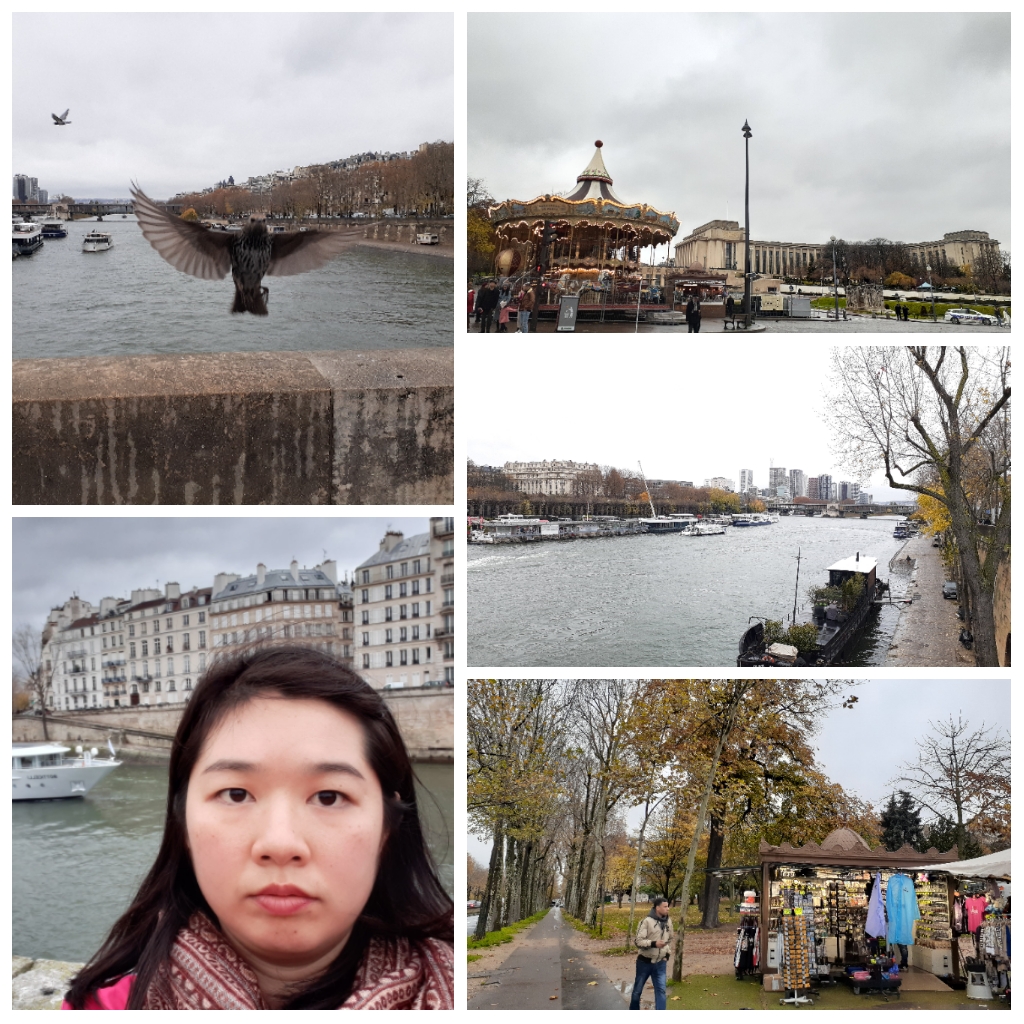

Around the corner
A cafe, a brasserie
Wicker chairs, outside


Tears came to my eyes
Seeing Notre Dame by day
Construction gives hope

Bastille and the Arch
Monuments to remember
Pantheon as well

DAY THREE
Croissants for breakfast
Like biting into Heaven
Butter and Texture


Fountainebleau Chateau
History lived within these walls
Napoleon, too


The Louvre. A must see
So many stolen treasures
Attracts the whole world

Mona Lisa smiles
While crowds of people gather
Stolen--then priceless

Sacre Coeur at night
A fortress of purity
Looks out at Paris

LASTING MEMORIES
Wining and Dining
Every mouthful is perfect
The French do it right!


So much to see--go, go, go
Endless cobblestone

Sunday, June 2, 2019
Shine Your Light
I write this post on the anniversary weekend of my grandfather's death. A week ago, I was in Honolulu, HI for the 20th Annual Lantern Floating, which honors those who have gone before us. Initiated by leaders of the Shinnyo-en Buddhist order, this event has become one that welcomes 50,000 people from all (or no) faiths and is fully supported by the local Hawaiian government.
As a sponsored guest of the Shinnyo-en Foundation, I had the opportunity to not only attend the Lantern Floating, but also to visit the Shinnyo-en Temple in Hawaii, to hear Her Holiness Shinso Ito (head of the Shinnyo-en order) speak at the Hawaii Convention Center, and to interact with Shinnyo-en Young Adults. All expense were paid for, which was absolutely amazing!
For more information on the Lantern Floating, check out this article on Hawai'i Magazine.
And to skip my narrative, scroll through for pictures!
 |
| All sponsored guests at the welcome dinner |
I understand what it's like to hold tightly onto one's faith, over and against that of others. When my parents converted to Christianity in their early '30s, they rejected much of their family members' beliefs in order to be "faithful." This caused years of misunderstanding and grief; we felt persecuted by our relatives in Taiwan, and they felt like they had lost us to the "American religion" of Christianity. I remember seeing conflict erupt between my dad and his mom--a devout Buddhist--and also hearing my uncles mock my mom. Our family prayed constantly for the "salvation" of our "unsaved" family members, and as I child I feared thinking of those I loved being sent to "hell." We visited Taiwan frequently, and I developed deep feelings of love for my family members--but often had to check myself so as not to get too attached to people whom I might not see in heaven someday.
In the last decade, relationships with our relatives have become much less strained. My family has extricated ourselves from previous Fundamentalist views, and we've been able to stop judging our "unsaved" loved ones and simply appreciate them for the wonderful (and flawed) human beings that they are. Our family members have also come to see us as "normal" again, and they now understand that Christianity is the way through which we have learned to express our spirituality in the American context. Several relatives have also become Christian--a year ago, my grandmother on my mom's side was baptized, and my grandfather on my dad's side was as well (along with a few other family members from that side of the family).
Through my interfaith internship, I have learned and interacted with lovely and generous (and social-justice-minded) individuals from many faiths: Bahai, Sikh, Islam, Jewish, LDS, and various Christian denominations. I have felt seen, heard, and respected in a very unique way, despite being a minority and a woman who looks young for her age. I have been told by older white men that my voice matters, and that I should feel free to speak freely with them--and even give them suggestions.
 |
| Aloha! Means Hello, Goodbye, and I Love You =) |
 |
| Buddhist-Muslim-Catholic dialogue |
This has never happened to me before in Christian settings, where men are automatically granted positions of leadership (even when they have not earned it) because of an "Ephesians 5" culture of deference to male authority. Walking into most Christian settings (with the exception of Mainline Protestant denominations, where women are proudly ordained and patriarchy is denounced), I sense that my seminary degree from Yale threatens male pastors and alienates me from others. Quite often, I am asked, "Did you meet any single young men at Yale?" (you should still look for someone to lead you) rather than, "What have you learned in seminary?" (God has called you to make a difference).
(In the eyes of many, women are not fully actualized in their potential until they are married and on their way to having kids. Conservative Christian settings especially idolize marriage, even though the very person who is credited with penning Ephesians 5 [the apostle Paul] also wrote that those who are single should not seek to be married--and that the person who is single can focus more on serving God rather than pleasing their spouse.)
But I digress.
In Hawaii, the question I received most was, "What would you like to write your dissertation on?" People were interested in my work and my life experience. As one of the sponsored guests, I was given a the opportunity to help lead roundtable discussions on "Growth Mindset"; to speak on camera about my experience at the Lantern Floating; and to share my reflections at a closing luncheon. I felt heard, seen, and respected--even though I had done nothing to earn that respect.
I experienced a taste of what men--and those who are white--are privileged to have. One automatically feels a sense of security when the most respected person in your community is someone who looks like you. This is the first time that I experienced this as an introverted Asian American woman.
Shinnyo-en is the only Buddhist order headed by a woman--Her Holiness Shinso Ito. She is 77 years old, a petite lady with a soft voice and an adorable laugh, which comes out often when she speaks. She is married but has no biological children--but has nurtured and led millions around the world through her religious practice and example.

When you look like someone who is given the highest honor within a religious and cultural system, you automatically feel that others respect you. When interacting with dozens of Shinnyo-en Young Adults, I felt as if their bows of deference and their attentive listening faces were genuine. I never had to second-guess whether I deserved to have a voice and be heard. And seeing Her Holiness speak--first at the Hawaii Convention Center, where we sat in the front row next to her husband, and then on the day of the Lantern Floating, when she performed the rites for the ceremony--I saw, for the first time in my life, someone who had achieved the most honored rank, who also looked like me. I saw myself in her, and I realized that in the right environment, I too could simply be the best version of myself, and receive recognition for it.
I wish I had more time to learn from the Shinnyo-en Young Adults. Some of them were raised by practicing parents, and others came to Shinnyo-en on their own. I heard stories of how becoming a practitioner has transformed individual lives--bringing them from anxiety and despair to calm and peace. As a form of esoteric Buddhism, Shinnyo-en focuses on inner qualities that go beyond words, and I could sense from the Young Adults that they drew from deep, still waters. Large group settings often give rise to anxious chatter; yet these Young Adults had a kind of inner calm that spilled out into their respectful demeanor. In our roundtable discussions, they deferred to one another to answer questions, speaking thoughtfully and humbly.
As a Christian, I felt fully embraced by this community. I spoke from the heart and was met by their hearts. I felt unworthy of their respect--and I was reminded of what Grace is: being treated better than you feel you deserve. I wanted to ask them about their practice and beliefs--some of it came out during their sharing--but was met with their insistence on asking me questions, since I was the sponsored guest! This was truly humbling--all I had to do was show up, and they had traveled from far and wide to learn leadership skills and to do volunteer work for the Lantern Floating. (When I was on my way to snorkel with dolphins, they were cleaning Ala Moana Beach in preparation for the evening.) As a sponsored guest, I was able to simply be myself in a space so generously hosted and created by others. There was nothing I had to earn or prove, and I have never felt this at ease in any other religious setting--and I have been in quite a few!
As a Practical Theologian concerned with how spirituality affects actual lived experience, I hope to learn more about Shinnyo-en Buddhism and its work of peace-building in the world.
 |
| Shinnyo-en Young Adults from all over the world |
 |
  |
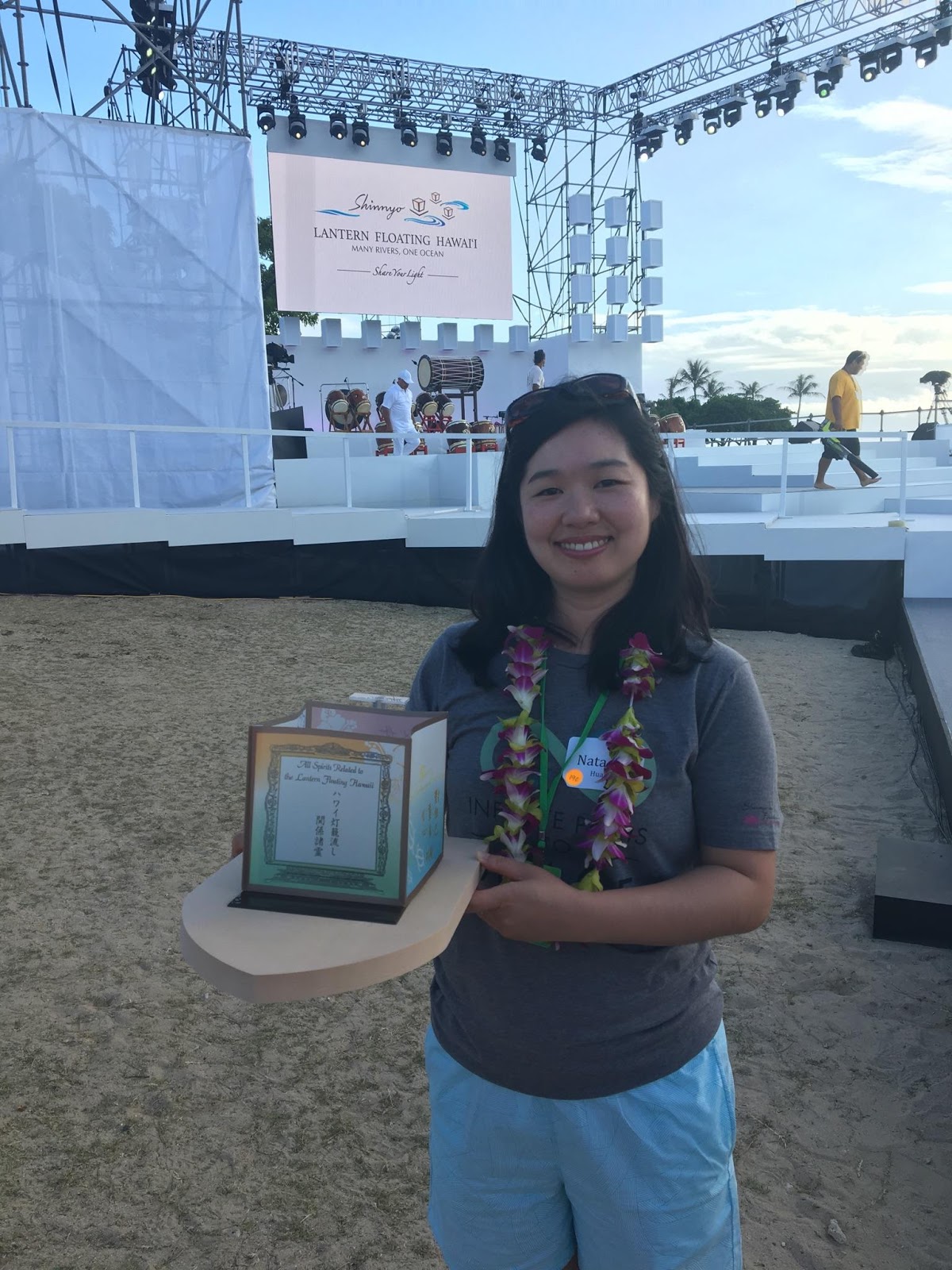
At 6 pm, the ceremony commenced with Taiko drumming, followed by various artistic performances from both Japanese and Hawaiian cultures. Young women scattered flower petals, and Shinnyo-en clergy processed to the stage in bright robes. Her Holiness performed a cleansing ritual, an abbreviated version of what she had already done earlier in the temple. The stage lighting made the whole thing feel a bit surreal, and the dramatic cloud formations in the background added to the occasion. I was pleased to see how supportive the local Hawaiian government is of this event, and many of the guests seated in our VIP section represented various facets of government and military branches.
Then, it was time to take our lanterns out into the water. As I waded out in my shorts, I felt like I was on the set of a big film production, one of 50,000 people gathered to pay their respects to the dead. At the same time, as a sponsored guest, my every step was being filmed, so I also felt like I had a highly individualized experience. Then, it hit me: I'd heard in seminary that the word "liturgy" has as one of its meanings, "the work of the people." Walking out with my lantern, gazing out onto the water where others' lanterns already floated, and making my way respectfully around individuals who were having an emotional moment before letting go of theirs, I thought to myself, "This is the work of the people."

I let go of my lantern, as if sending a message to my grandparents. Hawai'i, situated in the middle of the Pacific Ocean, was where my family had stopped to vacation in the past, en route to/on the way back from visiting our family in Taiwan. It was the perfect place to send my love to my 爺爺 and my 阿嬤, and watching my lantern float away gave me a sense of calm and peace.
 |
| Photo courtesy of my (new) friend Joe Fox, a sponsored guest from NYC (and former chief of transit in the NYPD) |
I found Joe, my new friend from NYC, who had also let go of his lantern, and we stood side by side in an embrace. There was no need for words--and he was usually a cheerful talker--only presence. There was nothing to do except simply be.
Eventually, we reconvened as a group, taking pictures, walking back to the VIP tent, and debriefing over tropical desserts. We were called away one by one to give interviews, and then the night was over. Back at the hotel, I took a shower and took some time to unwind. It had been a long day, from getting up at sunrise to catch a boat, to watching the sunset during the Lantern Floating ceremony. All thoughts that I had had from the day had been processed through our group sharing and reflecting--floating, as it were, into the night.
 |
| The five sponsored guests after Lantern Floating |
Many Rivers, One Ocean-Share Your Light
We feel the closeness of those who have gone before us in the warm glow of lanterns.
We fully honor them by expressing their best qualities and our innate goodness
--our shinnyo--
--our shinnyo--
in actions that create a brighter future for all.
~Shinnyo Lantern Floating Hawaii
Other Highlights from Hawaii:
 |
| Sunset picnic on the beach. Introvert time, after a full day of touring the Shinnyo-en Hawaii Temple, attending a Gathering with Her Holiness at the Hawaii Convention Center, and leading roundtable discussions with Shinnyo-en Young Adults. |
 |
| Sunset from Waikiki Beach (Sunday, May 26) |
 |
| At Ko Olina (west side of Oahu), embarking on snorkel adventure (Monday, May 27) |

 |
View from Dolphin Cruise ship, off the northwest coast of Oahu |
 |
| All underwater pictures taken by cruise ship crew |
 |
| Swimming with dolphins is actually harmful to them--it disturbs their rest. We kept our distance but enjoyed seeing them pass by! |
 |
| Sea turtles are endangered species |
 |
| We also kept our distance but were happy to observe from above water |
 |
| Spinning dolphins jump out of the water and do spinning somersaults |
 |
| There it goes! |
Photos taken and purchased from crew of the snorkel cruise. A friend I met on the boat went in on the pictures together, which justified spending the extra money!
 |
 |
My first time in Hawaii, I was 6 years old. It was a magical experience--I still remember attending a Luau and watching amazing feats involving knives and fire--and visiting a pineapple plantation. We snorkeled amidst beautiful coral and colorful fish in Hanauma Bay. Sadly, tourism has damaged much of the coral there and caused the marine life to leave--so I chose not to visit this time so as not to spoil my childhood memories.
 |
I did ask my Lyft driver to stop above it for a quick photo
on the way back from Sunrise on Sandy Beach.
|
  |
| Sunrise from Sandy Beach on my last morning in Hawaii (Wednesday, May 29) |

I'll be back, Hawai'i! Aloha until the next Aloha!
Monday, April 15, 2019
Subscribe to:
Posts (Atom)