Sunday, June 2, 2019

Shine Your Light


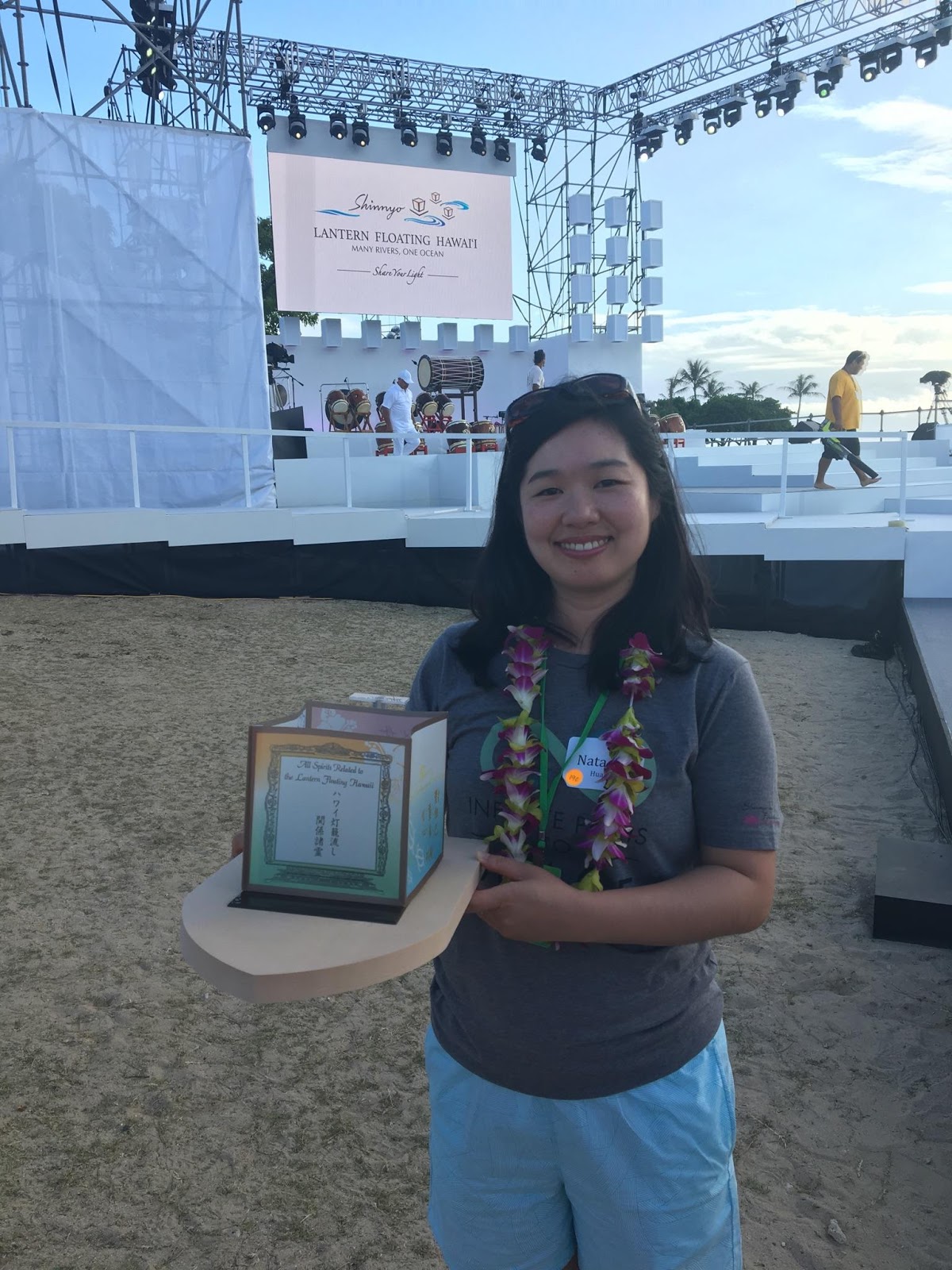
I write this post on the anniversary weekend of my grandfather's death.  A week ago, I was in Honolulu, HI for the 20th Annual Lantern Floating, which honors those who have gone before us.  Initiated by leaders of the Shinnyo-en Buddhist order, this event has become one that welcomes 50,000 people from all (or no) faiths and is fully supported by the local Hawaiian government.  

As a sponsored guest of the Shinnyo-en Foundation, I had the opportunity to not only attend the Lantern Floating, but also to visit the Shinnyo-en Temple in Hawaii, to hear Her Holiness Shinso Ito (head of the Shinnyo-en order) speak at the Hawaii Convention Center, and to interact with Shinnyo-en Young Adults.  All expense were paid for, which was absolutely amazing! 

By extending hospitality towards non-practitioners, The Shinnyo-en Foundation was fulfilling its mission of peace-building in the world.  There were no religious requirements or strings attached--all we had to do was simply show up and be ourselves, and to share our reflections.  I could not have been more impressed with how our itinerary was planned and carried out.  Every last detail was thought through, making us feel like the most honored guests in the world.

For more information on the Lantern Floating, check out this article on Hawai'i Magazine.  
And to skip my narrative, scroll through for pictures!

All sponsored guests at the welcome dinner
I had been connected to Shinnyo-en through my internship with the Orange County Interfaith Network, which began this past November.  The theme of my internship has been the phrase from Jesus' words in Matthew 5:16--"Let your light shine before others"--and I've used this to explain to some Conservative Evangelicals why I would participate in interfaith work.  To them, it seems, I have compromised my faith to support that of others.

I understand what it's like to hold tightly onto one's faith, over and against that of others.  When my parents converted to Christianity in their early '30s, they rejected much of their family members' beliefs in order to be "faithful."  This caused years of misunderstanding and grief; we felt persecuted by our relatives in Taiwan, and they felt like they had lost us to the "American religion" of Christianity.  I remember seeing conflict erupt between my dad and his mom--a devout Buddhist--and also hearing my uncles mock my mom.  Our family prayed constantly for the "salvation" of our "unsaved" family members, and as I child I feared thinking of those I loved being sent to "hell."  We visited Taiwan frequently, and I developed deep feelings of love for my family members--but often had to check myself so as not to get too attached to people whom I might not see in heaven someday.

In the last decade, relationships with our relatives have become much less strained.  My family has extricated ourselves from previous Fundamentalist views, and we've been able to stop judging our "unsaved" loved ones and simply appreciate them for the wonderful (and flawed) human beings that they are.  Our family members have also come to see us as "normal" again, and they now understand that Christianity is the way through which we have learned to express our spirituality in the American context.  Several relatives have also become Christian--a year ago, my grandmother on my mom's side was baptized, and my grandfather on my dad's side was as well (along with a few other family members from that side of the family).

Through my interfaith internship, I have learned and interacted with lovely and generous (and social-justice-minded) individuals from many faiths: Bahai, Sikh, Islam, Jewish, LDS, and various Christian denominations.  I have felt seen, heard, and respected in a very unique way, despite being a minority and a woman who looks young for her age.  I have been told by older white men that my voice matters, and that I should feel free to speak freely with them--and even give them suggestions.

Aloha!  Means Hello, Goodbye, and I Love You =)

Buddhist-Muslim-Catholic dialogue

This has never happened to me before in Christian settings, where men are automatically granted positions of leadership (even when they have not earned it) because of an "Ephesians 5" culture of deference to male authority.  Walking into most Christian settings (with the exception of Mainline Protestant denominations, where women are proudly ordained and patriarchy is denounced), I sense that my seminary degree from Yale threatens male pastors and alienates me from others.  Quite often, I am asked, "Did you meet any single young men at Yale?" (you should still look for someone to lead you) rather than, "What have you learned in seminary?" (God has called you to make a difference).

(In the eyes of many, women are not fully actualized in their potential until they are married and on their way to having kids.  Conservative Christian settings especially idolize marriage, even though the very person who is credited with penning Ephesians 5 [the apostle Paul] also wrote that those who are single should not seek to be married--and that the person who is single can focus more on serving God rather than pleasing their spouse.)

But I digress.

In Hawaii, the question I received most was, "What would you like to write your dissertation on?" People were interested in my work and my life experience.  As one of the sponsored guests, I was given a the opportunity to help lead roundtable discussions on "Growth Mindset"; to speak on camera about my experience at the Lantern Floating; and to share my reflections at a closing luncheon.  I felt heard, seen, and respected--even though I had done nothing to earn that respect.

I experienced a taste of what men--and those who are white--are privileged to have.  One automatically feels a sense of security when the most respected person in your community is someone who looks like you.  This is the first time that I experienced this as an introverted Asian American woman.

Shinnyo-en is the only Buddhist order headed by a woman--Her Holiness Shinso Ito.  She is 77 years old, a petite lady with a soft voice and an adorable laugh, which comes out often when she speaks.  She is married but has no biological children--but has nurtured and led millions around the world through her religious practice and example.


When you look like someone who is given the highest honor within a religious and cultural system, you automatically feel that others respect you.  When interacting with dozens of Shinnyo-en Young Adults, I felt as if their bows of deference and their attentive listening faces were genuine.  I never had to second-guess whether I deserved to have a voice and be heard.  And seeing Her Holiness speak--first at the Hawaii Convention Center, where we sat in the front row next to her husband, and then on the day of the Lantern Floating, when she performed the rites for the ceremony--I saw, for the first time in my life, someone who had achieved the most honored rank, who also looked like me.  I saw myself in her, and I realized that in the right environment, I too could simply be the best version of myself, and receive recognition for it.

I wish I had more time to learn from the Shinnyo-en Young Adults.  Some of them were raised by practicing parents, and others came to Shinnyo-en on their own.  I heard stories of how becoming a practitioner has transformed individual lives--bringing them from anxiety and despair to calm and peace.  As a form of esoteric Buddhism, Shinnyo-en focuses on inner qualities that go beyond words, and I could sense from the Young Adults that they drew from deep, still waters.  Large group settings often give rise to anxious chatter; yet these Young Adults had a kind of inner calm that spilled out into their respectful demeanor.  In our roundtable discussions, they deferred to one another to answer questions, speaking thoughtfully and humbly.

As a Christian, I felt fully embraced by this community.  I spoke from the heart and was met by their hearts.  I felt unworthy of their respect--and I was reminded of what Grace is: being treated better than you feel you deserve.  I wanted to ask them about their practice and beliefs--some of it came out during their sharing--but was met with their insistence on asking me questions, since I was the sponsored guest!  This was truly humbling--all I had to do was show up, and they had traveled from far and wide to learn leadership skills and to do volunteer work for the Lantern Floating.  (When I was on my way to snorkel with dolphins, they were cleaning Ala Moana Beach in preparation for the evening.)  As a sponsored guest, I was able to simply be myself in a space so generously hosted and created by others.  There was nothing I had to earn or prove, and I have never felt this at ease in any other religious setting--and I have been in quite a few!

As a Practical Theologian concerned with how spirituality affects actual lived experience, I hope to learn more about Shinnyo-en Buddhism and its work of peace-building in the world.
Shinnyo-en Young Adults from all over the world


The actual Lantern Floating took place on Memorial Day.  That morning, I had gone snorkeling with spinning dolphins and sea turtles, using some of my meal allowance to pay for the trip.  (By shopping at the local grocery mart rather than eating out every meal, I was able to save quite a bit of money to use for other expenses.)  By the afternoon, I had gathered with the others inside the VIP Tent on the beach, where we assembled our lanterns (I wrote messages to my grandfather on my mom's side and my grandmother on my dad's side, both of whom have passed away in the last 5 years) and ate dinner--the buffet had delicious pasta, sushi, and curry.

At 6 pm, the ceremony commenced with Taiko drumming, followed by various artistic performances from both Japanese and Hawaiian cultures.  Young women scattered flower petals, and Shinnyo-en clergy processed to the stage in bright robes.  Her Holiness performed a cleansing ritual, an abbreviated version of what she had already done earlier in the temple.  The stage lighting made the whole thing feel a bit surreal, and the dramatic cloud formations in the background added to the occasion.  I was pleased to see how supportive the local Hawaiian government is of this event, and many of the guests seated in our VIP section represented various facets of government and military branches.

Then, it was time to take our lanterns out into the water.  As I waded out in my shorts, I felt like I was on the set of a big film production, one of 50,000 people gathered to pay their respects to the dead.  At the same time, as a sponsored guest, my every step was being filmed, so I also felt like I had a highly individualized experience.  Then, it hit me: I'd heard in seminary that the word "liturgy" has as one of its meanings, "the work of the people."  Walking out with my lantern, gazing out onto the water where others' lanterns already floated, and making my way respectfully around individuals who were having an emotional moment before letting go of theirs, I thought to myself, "This is the work of the people."

I let go of my lantern, as if sending a message to my grandparents.  Hawai'i, situated in the middle of the Pacific Ocean, was where my family had stopped to vacation in the past, en route to/on the way back from visiting our family in Taiwan.  It was the perfect place to send my love to my 爺爺 and my 阿嬤, and watching my lantern float away gave me a sense of calm and peace.
Photo courtesy of my (new) friend Joe Fox, a sponsored guest from NYC (and former chief of transit in the NYPD)
I lingered in the water after losing sight of my lantern, wending my way around others and taking it all in.  I had to breathe deeply and slowly to prevent tears from coming out--I'm not adverse to showing emotion, but crying on camera is another matter.  All I wanted to do was hug someone.

I found Joe, my new friend from NYC, who had also let go of his lantern, and we stood side by side in an embrace.  There was no need for words--and he was usually a cheerful talker--only presence.  There was nothing to do except simply be.

Eventually, we reconvened as a group, taking pictures, walking back to the VIP tent, and debriefing over tropical desserts.  We were called away one by one to give interviews, and then the night was over.  Back at the hotel, I took a shower and took some time to unwind.  It had been a long day, from getting up at sunrise to catch a boat, to watching the sunset during the Lantern Floating ceremony.  All thoughts that I had had from the day had been processed through our group sharing and reflecting--floating, as it were, into the night.

The five sponsored guests after Lantern Floating
Many Rivers, One Ocean-Share Your Light

We feel the closeness of those who have gone before us in the warm glow of lanterns.  
We fully honor them by expressing their best qualities and our innate goodness
--our shinnyo--
in actions that create a brighter future for all.

~Shinnyo Lantern Floating Hawaii

"Share your light," Her Holiness had set for the theme of this year's Lantern Floating.  I had done so--I had let my light shine before others.  This was the experience of a lifetime, and I would be forever be grateful.  Mahalo (gratitude/Hawaiian) Itsumademo (forever/Japanese)!


Other Highlights from Hawaii:
Sunset picnic on the beach.  Introvert time, after a full day of touring the Shinnyo-en Hawaii Temple, attending a Gathering with Her Holiness at the Hawaii Convention Center, and leading roundtable discussions with Shinnyo-en Young Adults.

Sunset from Waikiki Beach (Sunday, May 26)

At Ko Olina (west side of Oahu), embarking on snorkel adventure (Monday, May 27)


View from Dolphin Cruise ship, off the northwest coast of Oahu 

All underwater pictures taken by cruise ship crew
Swimming with dolphins is actually harmful to them--it disturbs their rest.
We kept our distance but enjoyed seeing them pass by!


Sea turtles are endangered species

We also kept our distance but were happy to observe from above water

Spinning dolphins jump out of the water and do spinning somersaults

There it goes!

Photos taken and purchased from crew of the snorkel cruise.  A friend I met on the boat went in on the pictures together, which justified spending the extra money!


On Tuesday, May 28th, I hiked Diamond Head for a great view!   


My first time in Hawaii, I was 6 years old.  It was a magical experience--I still remember attending a Luau and watching amazing feats involving knives and fire--and visiting a pineapple plantation.  We snorkeled amidst beautiful coral and colorful fish in Hanauma Bay.  Sadly, tourism has damaged much of the coral there and caused the marine life to leave--so I chose not to visit this time so as not to spoil my childhood memories.  

I did ask my Lyft driver to stop above it for a quick photo 
on the way back from Sunrise on Sandy Beach.


Sunrise from Sandy Beach on my last morning in Hawaii (Wednesday, May 29)


I'll be back, Hawai'i!  Aloha until the next Aloha!

Monday, April 15, 2019

Saturday, March 30, 2019

Preschool and PBS

(My brother and) I may have been indoctrinated--and more heavily in certain periods than others--with Christian Fundamentalist Conservative Right-Wing thought growing up, but we were never brainwashed.  I credit that to having attended a hippie preschool, where creativity reigned and children played.  Mom had the foresight to find us a loving educational community where parents were involved in the co-op.  I still have very fond memories of playing and reading and napping and crafting.  I remember my friends and their parents as faces soaking up the sun, and my own mom was there too.

In elementary school, we were homeschooled, but our brains remained active and imaginative, curious and creative.  We watched PBS shows and Nature shows and Mister Rogers.  We learned to value kindness and connectedness rather than cruelty and competitiveness.  We watched Huell Howser explore "California's Gold" and adventured with "Reading Rainbow."  We tuned in to "This Old House" on Saturday mornings and were captive audiences to ballet and opera performances those same evenings.  We never stopped learning, and learning and living were one joint enterprise.

In later years--my high school years, mainly--we would become staunchly Republican and Fundamentally Christian.  I adopted the lingo and mindset of those communities, but I never lost my inner soul.  In college, I chose my Christian friends based on their dedication to faith and doctrine, but outside of Christian settings, my friends were liberals.  Those friends were not hard to find--I lived in the honors dorm at USC and studied music.  I was somehow "cool" and "chill" enough to not be avoided by the brilliant and talented students in those programs, despite being a "strong Christian."

I now know that, deep down, you will always be what you were meant to be, especially if your formative years allowed you to be your true self.

In that sense, Mom parented as she was meant to parent, in the days before fear and anxiety took over and brought her over to the more structured curriculum of the Religious Right, and for that golden "age of innocence," I am grateful.

Wednesday, March 27, 2019

Cast and Crew

Being at Yale Divinity School was like being on set for a two-year filming process.

The cast and crew formed a community that was unique to that particular time.  

Recently, I watched quite a few interviews with the cast of The Sopranos.  They felt like working on the show was like creating a family.  They are still good friends to this day, although it's a rare occasion when they can all be together all at once.  They also said that the show "spoiled" them in the sense that other sets are usually not so cohesive and communal.  Sometimes, when all the right people are cast for all the right parts, and the writing is amazing, pure magic happens.  

That is what Divinity School was like for me.  My cohort was knit together by threads of experiences and conversations that previous and future cohorts did not experience.  The crew--our professors, administrators, and the staff of Marquand Chapel--supported us fully, and we were free to express ourselves because of that support.

As in acting, we brought our full selves to the process--and yet, because of the chemistry of the community, we also brought our best selves.  Actors shine on screen in a way that does not always happen in real life, because only on set are the conditions there.  In Divinity School, I often glimpsed what heaven must be like--and I knew that outside of that bubble of time and space, I would probably never taste it again, to that extent.

Actors often end up dating each other, and that's understandable, because only those who share an experience have any idea what it was like.  How do you explain a miraculous journey to someone who wasn't on it?

I hadn't necessarily planned on marrying someone from Divinity School going in, but I did fall in love with a fellow cast member.  On set, it worked.  In that community, we were compatible.  Even after filming ended, we went on enough interviews and promotional tours together that the magic continued to develop.  

As those community-building settings grew fewer and far between, we worked hard to sustain the chemistry we had sparked with each other.  And even now, at the end of it, I'll still remember the good moments, when the camera was rolling, and we were at our best.

And that's a final cut!

Sunday, March 24, 2019

Working on the Sabbath

It's Sunday, and I'm cheerfully typing away at my computer, sending emails for my Interfaith Internship and giving thanks for once-in-a-lifetime opportunities that come to mind.

It's not exactly bringing "the sacrifice of praise into the House of the Lord," as an old praise song goes, but I think God delights in the sight of me sitting comfortably on my bed, with the windows open, enjoying the peace and quiet and bird chirps as my computer helps me communicate with the outside world.

Jesus was accused of not keeping the Sabbath, but he reminded those around him that it was important to be out and about, engaging with life outside of the Jewish Synagogue.  He went places that "no good Jew" would go--the homes of tax collectors, the wells of Samaritans--and that was what his Gospel was all about.

I had dinner last night with a Jewish rabbi, the executive director of a foundation that supports Shinnyo-en Buddhism in the U.S., and three members of an Episcopalian Church in Orange County.  It was a wonderful time, and it didn't hurt that I was eating the best Italian food I've had since moving back from Boston.

I've expanded my personal quest for healthy spirituality from Ecumenical relationships to Interfaith collaboration.  Jesus has been with me every step of the way, and in some ways, my Interfaith Internship has fulfilled desires that I once thought would be met working in full-time Christian ministry, married to the pastor I had been dating.  God certainly operates outside of the box of my limited thinking!

Proverbs 3:5 comes to mind.  How easy it is to lean on our own understanding, when trust is the key.  I want to acknowledge the Lord in all my ways--even those that don't seem to be a "typical" (Evangelical) Christian engagement: skipping church, supporting other faith traditions, and praising God in the midst of it!

*P.S.--I do take personal Sabbaths, where I put aside work emails and reading, usually from Friday afternoon to Saturday evening.  This follows the Jewish (and SDA) tradition of Shabbat.

Going through the Motions

I attended a concert at Segerstrom Hall in Orange County on Thursday.  The Pacific Symphony has been led by Carl St. Clair for nearly 30 years.  Thirteen years ago, when I was a Sophomore at the University of Southern California, Maestro St. Clair conducted us in Tchaikovsky's Pathetique.

Watching him from the "other side," as an audience member rather than an orchestra musician was very interesting.  He memorizes the entire concert and does away with the baton.  He conducts with us entire body, including his face.  His ethos is that of listening closely.

It may come as a surprise that not all orchestra conductors value listening in that way.  Many musicians rely on the baton for the beat, or sometimes, conductors have to adjust their beat to what musicians (often the loudest ones, like brass or timpani) have already set.

St. Clair achieves a kind of unity, drawing out sound from the orchestra as if it were a single organism with many parts.  Every note is meaningful, even notes that most conductors would pass through in order to get to the climax.

Carl St. Clair is not one to simply go through the motions.  In nearly a decade of orchestra experience, he was my favorite conductor, and playing under his leadership was a transformational, transcendent experience.

In life and art, do we go through the motions, or do we let the motions go through us?  In the journey of faith, do we do what's expected of mature Christians, or do we let faith take us wherever it needs to go?  Some people I know feel that Jesus has led them out of Evangelicalism.  Others may denounce such claims.  I wonder what Jesus would say to all of that.

In my Wednesday evening class on Contemplative Practices, our professor says, "We do the practice, but sometimes, the practice does you."  Few experiences in life allow for a feeling of transformation and transcendence.  But the arts the mysticism strive to.

Carl St. Clair is one of the longest tenured conductors of a major American orchestra.  Perhaps the secret to this longevity is the transformational, transcendent power of music, and his willingness to fully embody and channel its power.

Wednesday, March 20, 2019

Staying in Shape

My personal goal has never been to "make disciples of all nations."  Ever since I could remember--and in all iterations of my personal faith journey--I have cared most about people experiencing wholeness and wellness.  For me, that often includes life with Jesus.  But I won't force it on anyone else, unless they genuinely catch a spark and want to know more.

I teach both violin and piano, and it is a fact that some people are better suited to certain instruments.  For the violin, one must have a good enough ear to distinguish between almost-in-tune and perfectly-on-pitch.  You can be a very competent pianist but lack this ability on the violin.

Of course, listening skills can be developed, and perhaps it is good to counterbalance amazing sight reading skills with the discipline of memorizing notes and not using music.  If the point is to grow as a musician, then balance is necessary.  But it's also more productive sometimes to play to one's strengths.

So it is with sports.

My favorite sport is soccer, but I'm decent at basketball and volleyball.  Baseball is hard for me, and tennis is achievable but doesn't feel very natural.  In high school, I ran cross country for one summer, and it became very apparent after a few weeks of training who was beginning to sustain injuries.

Maybe some of us are naturally born with stronger joints.  Maybe some of us do better with non-contact movement, such as swimming.  Soccer may have changed my life and transformed my self-confidence, but if a friend of mine gets his high playing basketball, I'll just as happily cheer him on in shooting hoops.  Maybe he's got big hands and can control the ball very well, whereas I've always had "thunder thighs" and a weaker upper body.

If this is how "real life" works, then why do we suddenly become so exclusivist when it comes to personal faith?  Some of us may not be born with the "ear" to hear from God in a Pentecostal/charismatic manner.  Others of us may not be as good as devouring Scripture, because reading is hard.  Some of us may have a real hard time "feeling God's love"--though we ask for it repeatedly.  Others of us may instinctively embrace Divine mysteries but shudder at doctrine and morality.  Some of us have the faith to receive instant healing from God; others have the perseverance to struggle and suffer for years on end.

Julian of Norwich, a Catholic mystic who had personal encounters with Christ, is known for her phrase: "all shall be well, and all manner of things shall be well."  A famous hymn goes, "It is well...with my soul."

Humans should seek to thrive, otherwise life is not worth living.

If you've been told to spend more time on the treadmill in order to get healthy, but it's giving you a leg cramp, just stop!  Try yoga instead, or go for a bike ride.  If your religion is making you feel less whole than you know you were born to be, then seek God in other ways.  God will meet you wherever you come most alive.

And, in the words of Julie Walters' character in Mamma Mia 2: "Do what makes your soul shine!"